
 By
By 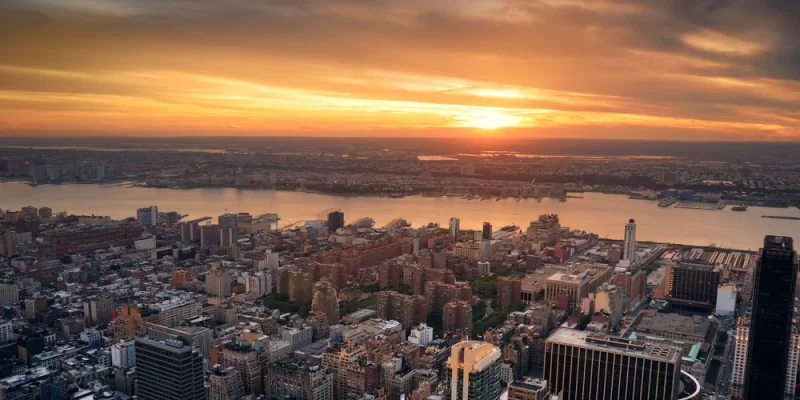
A city skyline does not remain visually constant throughout the day. Changes in the sun’s position, atmospheric conditions and artificial lighting affect the visibility, colour, contrast and apparent detail of buildings.
These differences can be particularly noticeable from an elevated viewpoint such as a rooftop bar, where a wider section of the surrounding city may be visible. Understanding how light changes from midday to night helps explain why the same skyline can appear different within a matter of hours.
How Does a Skyline View Change Around Midday?
Around midday, the sun is generally higher in the sky than during the morning or late afternoon. This changes the direction and length of shadows across buildings and other structures.
With the sun at a higher angle, shadows tend to be shorter. Architectural features that depend on side lighting for contrast may therefore appear less pronounced than when the sun is lower.
Several other factors can influence a midday skyline:
- Brightness: Strong daylight can make building surfaces and reflective materials appear particularly bright.
- Glare: Sunlight reflecting from glass façades, windows or water can temporarily reduce visual comfort or obscure details.
- Cloud cover: Clouds can diffuse direct sunlight, reducing strong contrasts between illuminated and shaded surfaces.
- Atmospheric conditions: Humidity, haze and airborne particles can reduce the clarity of distant buildings.
- Viewing direction: Buildings facing the sunlight may appear differently from those viewed with the sun behind them.
Additionally, at a skyline bar in Singapore, these effects can vary with weather conditions and the direction of the view. Singapore’s tropical climate also means clouds, humidity and rainfall can influence visibility throughout the day.
Overall, midday generally provides strong natural illumination, while glare and atmospheric conditions can affect how clearly distant parts of the skyline can be seen.
Why Are Skyline Views Different Around Sunset?
As sunset approaches, the sun moves lower towards the horizon. Sunlight then passes through more of the Earth’s atmosphere before reaching an observer, which contributes to the warmer colours commonly associated with sunrise and sunset.
The lower angle of sunlight also produces longer shadows. This can increase visible contrast across building façades and make the outlines of structures more distinct.
A sunset skyline can change relatively quickly because:
- The angle and intensity of natural light are continuously decreasing.
- Buildings may appear as silhouettes when viewed towards the setting sun.
- Artificial lights begin to become visible as ambient daylight declines.
- Clouds can reflect or block sunlight, altering the colours and brightness of the sky.
- The direction of the viewpoint determines whether the setting sun is directly visible.
From an elevated location such as a rooftop bar, the transition may be easier to observe because buildings, the horizon and changing sky conditions can be visible within the same view.
Sunset therefore represents a transition from strong natural illumination towards lower light levels, setting the stage for twilight.
What Happens to a Skyline During Blue Hour and Twilight?
Twilight is the period when the sun is below the horizon but sunlight continues to illuminate the upper atmosphere. It occurs after sunset and before night, as well as before sunrise.
Blue hour is commonly used in photography to describe part of twilight when the sky can take on a predominantly blue tone. It is not necessarily a full hour, as its duration varies according to location, season and atmospheric conditions.
During this period, a skyline often contains both natural and artificial light. Several visual changes occur:
- The sky gradually becomes darker as twilight progresses.
- Street lighting and illuminated buildings become increasingly prominent.
- Building outlines may remain visible against the remaining light in the sky.
- Differences between brightly lit and unlit structures become stronger.
- Reflections from windows, water and other surfaces may become more noticeable.
That said, for visitors viewing the city from a skyline bar, twilight can show the gradual shift between the daytime appearance of buildings and their illuminated night-time appearance.
In short, blue hour and twilight form a visual bridge between sunset and night, with natural light fading as artificial lighting becomes more dominant.
What Makes a Skyline View Different at Night?
Once natural daylight has largely disappeared, artificial lighting becomes the main source of illumination across an urban skyline. Office windows, residential buildings, streetlights, signs and architectural lighting can all contribute to the night-time cityscape.
This shift changes which features attract attention. A building that is visually prominent during the day because of its size or façade may become less noticeable at night if it has limited exterior lighting, while illuminated structures may stand out more clearly.
Night-time views can also be affected by:
- Interior reflections: Viewing through glass can create reflections from nearby indoor lights.
- Light pollution: Artificial light scattered in the atmosphere can brighten the night sky.
- Weather: Cloud, rain, mist and haze can reduce visibility or scatter artificial light.
- Distance: Atmospheric conditions can make distant illuminated buildings appear less distinct.
- Viewing environment: Bright lighting close to the observer can reduce the visibility of darker features in the distance.
The night skyline is therefore shaped primarily by artificial illumination rather than direct sunlight. This creates a different distribution of brightness and contrast compared with midday, sunset and twilight.
Contact NOVA and experience how changing daylight and city lights transform the view from a rooftop bar.
Comments